In today’s Gospel Reading, Jesus appears – after His Resurrection – to two of His disciples as they walked the road to Emmaus. These disciples did not realize it was Jesus, and this event moreover took place well before His Resurrection became known; only news of His death and burial had at that point spread among Christians. Accordingly, these disciples confided their distress to this traveler Whom they did not realize was Jesus, saying to Him, “… but we were hoping that [Jesus] would be the one to redeem Israel…” (Luke 24:21)
Notably, Jesus did not respond with affirming words assuring them that their despondency was acceptable or even understandable. Quite the opposite, He admonished them with a strong and well-placed rebuke:
“Oh, how foolish you are! How slow of heart to believe all that the prophets spoke!” (Luke 24:25)
In the talks that one may hear in these days following Easter, it is unfortunately sometimes said that the Resurrection was utterly surprising and unexpected. In fact, nothing could be further from the truth. The disciples’ unwillingness to believe, after His death, that Jesus would indeed rise from the dead was a testimony to their vices, not their virtues – vices, I hasten to add, which vanished like foam under a burning sun upon the descent of the Holy Spirit at Pentecost.
Not only was the Resurrection of the Christ foretold by the very Old Testament prophecy that any faithful Jew should have been well versed in (as affirmed by St. Paul in 1 Corinthians 15:4 and itself found in Psalm 49:15, Isaiah 25:8, Ezekiel 37, Hosea 13:14, and many other places). Not only that. It was also promised by Jesus Himself, in utter clarity, well before His death. It was even promised by Him precisely when the disciples’ Faith should have been at its zenith; immediately after the Transfiguration, wherein He clearly displayed His Divinity:
“And as they were coming down the mountain, [Jesus] charged them to tell no one what they had seen, until the Son of man should have risen from the dead. So they kept the matter to themselves, questioning what the rising from the dead meant.” (Mark 9:9,10)
Gee. Maybe “Rising from the dead” means rising from the dead!
The various vices of the disciples before Pentecost are included in the New Testament for our instruction. Peter looked down as he walked on the water and only then began to sink; this reminds us to keep our gaze firmly fixed on Jesus, no matter what storms are swirling about us. (Matthew 14). The disciples foolishly argued about who among them was the greatest (Luke 22); this reminds us that true exaltation is found only in humility. On the list goes.
The disciples’ initial unwillingness to take Jesus’ words at face value – to place absolute faith, trust, and hope in His promises no matter how grandiose or seemingly impossible from a human standpoint – was just another one of their vices which we must learn from and avoid.
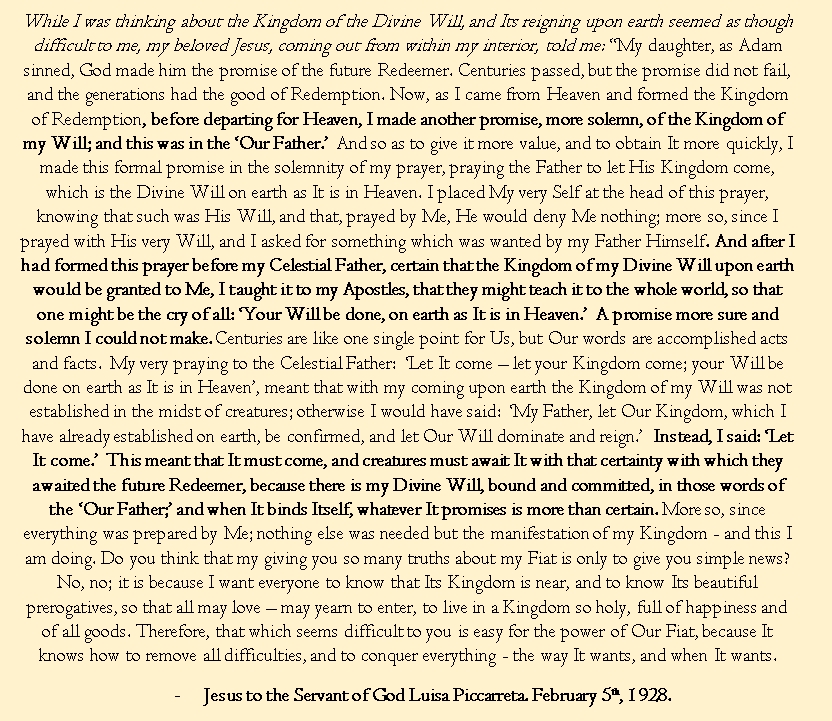
Jesus’ clearest promise in the whole Gospel, however, is found in the climax of the one and only prayer He taught: the Our Father. It is His promise that the Will of God shall reign on earth as in Heaven. Just as He meant exactly what He said when He promised He would “rise from the dead,” so too He meant exactly what He said when he prayed, prophesied, promised, and commanded us to pray:
“Thy Kingdom come. Thy Will be done on earth as it is in Heaven.” (Matthew 6:10).
This. Will. Happen. It is, moreover, a promise that has been reiterated by more prophecies, Popes, Fathers, mystics, and approved revelations than I can count. (See Part Five of Thy Will Be Done for a small sampling.) As we experience the continuation of the global Chastisements we are now enduring – but which are about to grow much more severe – we must, more than ever before, remind ourselves of this promise just as the disciples should have been reminding themselves, after Christ’s death, of His promise of Resurrection. For the Church must follow the life of her Head, therefore she too will endure her own Passion and enter into the tomb. But she will rise again, more glorious and triumphant than ever before. And I believe that your own eyes will see it.
***
After Jesus revealed to the disciples who were on their way to Emmaus who He was – by “breaking the bread” (that is, saying Mass and thus opening their eyes through the Eucharist) – He vanished out of their sight (Luke 24:31). Immediately, the two turned to each other with glances that doubtless pierced the soul of each, and said:
“Were not our hearts burning within us while he spoke to us on the way and opened the Scriptures to us?” (Luke 24: 32).
Whoever you are, I am sure you have experienced a time in which your heart was burning within you upon contemplating God’s promises. Perhaps a powerful experience at Mass or Eucharistic Adoration; a Confession that illuminated your conscience as never before; a pilgrimage that reminded you of the nothingness of this life and the closeness of Eternity; reading a book that exposed you to whole new spiritual realms; a severe suffering or loss whose pain was palpably exceeded by an outpouring of Heavenly grace; or even just looking out upon the beauty of creation as the glorious sun sunk beneath the horizon’s pine covered green mountains to the tune of a gentle breeze and the warbling of birds. Whatever it was, recall it, and let your task this Easter be to enter back into the glory of this moment and reclaim the Divine Hope veiled by it, that you may then proclaim this Hope to the whole world.
Spanish and Hungarian translations of The Crown of History are now complete. I’m now working on typesetting/formatting/etc., and I will soon publish them. Also: Portuguese, Spanish, Italian, French, Croatian, and Turkish translations of Thy Will be Done are now in the works. Stay tuned!
Divine Will Orthodoxy: In the few years since I last addressed this issue, but especially lately, I’ve again noticed some problematic interpretations of Luisa’s writings seeping back into discourse on these sublime, authentic, orthodox revelations. This must be addressed. If, therefore, you’re among those now being blessed by Jesus’ revelations to Luisa – and especially if you are frequenting the writings/talks of people promoting these revelations – then please heed this post, and kindly consider sharing it with those who may have been exposed to the problematic interpretations: https://danieloconnor.wordpress.com/divine-will-orthodoxy/ . It is imperative that we not allow the bad interpretations of the Divine Will revelations to spread unchecked.
And, some lengthier announcements/prophetic thoughts are at the bottom of this post
Have Holy Weeks in years past sailed right on by, leaving you only with the feeling that you did not do enough to appropriate the graces that God readily pours out in these holiest of days? Or are you simply hoping to ensure that this year’s Holy Week is particularly powerful? Either way, I have one recommendation:
(Or, here, and here, are pages I found where you can order them. I don’t have these particular copies though, so I cannot speak to their quality.)
In these extraordinary private revelations, Jesus tells the Servant of God Luisa Piccarreta about all the details of His Passion – from the moment He departed from His Mother before the Last Supper, up to His being laid in the tomb after His death on the Cross. But these pages do not merely convey a history lesson. Rather, by asking God for the Gift of Living in the Divine Will, and proceeding to read these Hours prayerfully, we mystically enter into the Passion along with Christ and console His Sacred Heart, satiating His thirst on the Cross. What then transpires is so powerful that, Jesus tells Luisa, a soul can be saved for each word we read of the Hours. He moreover promises that protection from the Chastisements can be afforded to those places where these Hours are prayed.
So, what should you do this Holy Week?
In addition to whatever else you have planned (which hopefully includes fasting, prayer, a good Confession, and participating in the Holy Week Liturgies): open the Hours and read. It is that simple. Don’t fret about the “right” way to “do them.” Just do them.
Many people inexplicably feel great aversion to beginning this conquest. Some invisible force battles against them so much as picking up this book (or printing out or opening up the PDF!) and even reading a few words. I assure you that this is nothing other than the devil doing his best to prevent you from reading the Hours, for he knows how destructive they are to his diabolical plans. Implore God’s grace, and command yourself to simply do it anyway.
It would be wonderful if you can manage to read the entire Hours this Holy Week, but nevertheless remember: a little is infinitely better than nothing. This, incidentally, is one of the keys to the spiritual life in general: never allowing our concerns about what we feel we won’t be able to accomplish prevent us from doing the small, easy, simple thing before us right now that we certainly can accomplish. God can multiply even a miniscule effort to bear enormous fruit. But what are we left with when we attempt to multiply even the largest conceivable number by zero? We are, of course, still left with nothing.
Note: The “Reflections and Practices” often included after each of the 24 Hours was written by St. Hannibal himself. They are amazing and I strongly encourage reading them! Some other editions of the Hours also include, at the end of each Hour, relevant passages from Luisa’s Volumes. These, too, are very good to read. But, strictly speaking, the Hours themselves do not include either of these; so if you are pressed for time, you can simply read just the content of the Hours.
***
Two posts ago, I explained why nuclear war would not and will not be the humanity-ending or civilization-ending event depicted within popular dystopian fiction, for example, “The Road” (this movie doesn’t explicitly name nuclear war as the apocalypse depicted, but it’s implicit and that’s how most people regard it), or perhaps the “Mad Max” movies (though I haven’t seen them.) Because of that explanation, I received one of the more amusing accusations I’ve yet secured – even more amusing, indeed, than when I was denounced as a freemason because of how I held my fingers when I counted to three on my hand in this video! This time, I was accused of being a government operative tasked with causing nuclear war by downplaying its severity. Well, I’m sorry to disappoint those who were hoping for some Malachi-Martin-esque intrigue, but I really am just a lowly adjunct philosophy professor [Another reminder, as I recently noticed some sites mistaken on this: I’m in my fifth year of working on my PhD, but I don’t have it yet – so I am not yet “Dr. O’Connor”]. But as I made clear in that very post, nuclear war would indeed be utterly apocalyptic and destructive to a degree without precedent in history since the Flood itself, or perhaps the Black Death. But truth trumps everything, and the notion that nuclear war would essentially (or even actually) end humanity are nothing but so-called “noble” lies; lies which, as with all lies, must be refuted. As the Chastisements that must come begin to enter into new stages, you must never let your hope waver. The Glorious Era of Peace is absolutely guaranteed, by Divine Decree, to follow these Chastisements. And that promise from Our Lord will be fulfilled so long as God is God.
So be hopeful, but be more hesitant with worldly optimism. It may be that relatively little of the latter will be called for in the coming days, even if some developments seem to indicate positive trends.
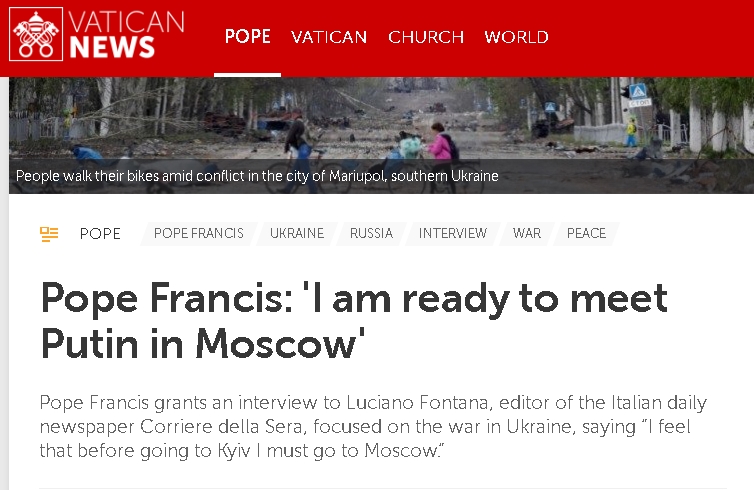
Pope Francis’ March 25th Consecration was undoubtedly a wonderful thing and I am sure it will bear good fruit. But I don’t think it was, well, “wonderful enough.” There wasn’t a requirement for all Bishops to participate, and there was the dilution of consecrating Russia by consecrating “ourselves, the church, and all humanity, especially Russia and Ukraine.” Alas, at least Russia was named, and all Bishops were encouraged to participate, so I see no reason to regard it as “invalid.” (Though we are, of course, not talking about a literal Sacrament here.) Most importantly, let us, dear faithful, ensure we do our part: the First Saturday Devotion (and not only five of them; let us do so perpetually). Is what has transpired enough to avert World War 3? That will depend upon the Faithful. But my guess? No, it won’t. I hope I’m wrong, but I still think WW3 is coming. If this message to Gisella Cardia is authentic (forgive the repetition, but yet again I should say: I encourage discerning Gisella and taking her messages seriously, but not presuming validity – personally, I haven’t undertaken the discernment process I’d need to before feeling convicted in her authenticity), then WW3 is coming, notwithstanding the Consecration. The Medjugorje message given on the very day of the March 25th consecration was beautiful – there, Our Lady reminded us that she is listening to our prayers for peace – but there was no indication therein that anything had been averted by the events of that day. What is more, the Signs of the Times in this regard are only accelerating. Putin is only becoming even more violent, and Finland – which shares a 1,300km border with Russia – just signaled its intent to join NATO. (Recall that Putin’s desire to keep NATO away from Russia’s borders was a – if not the – primary reason he invaded Ukraine.) Meanwhile, NATO is undertaking its own massive eastern-flank troop buildup. If, dear critic, I’m just a “doom and gloom fearmongerer” for saying I think these things likely portend WW3, what do you suppose they portend? In any event, as my readers know well, I say none of this to instill fear; you who trust in God have nothing to fear. I say it only to instill a sense of urgency in engaging in The Mission, and to inspire you to spend less time distracted by naïve worldly daydreams about the future.
God’s love for us is perfect. He loves us far too much to stand by idly and watch us lounge in our comfort, luxury, safety, and security, even when in doing so we damn our souls to hell – or at least consign them to a particularly long and painful Purgatory. Therefore, if we spurn His repeated calls to sanctity for too long, then He sends us a Cross that is sure to do the job.
We, dear fellow Westerners, now collectively need that Cross. And it is coming very soon.
I was reminded of this fact today as I watched the following short video about the Church’s newest Servant of God – and Pakistan’s first – Akash Bashir:
These completely impoverished and severely persecuted Pakistani Catholics show us what the Catholic Faith is supposed to be.
Look at that parish.
Look at how the people pray.
Look at the love, the devotion, the zeal, and the sincerity they all clearly have in their Eucharistic Lord.
Look at the vigor and vitality – forget pews, as those would prevent fitting in the 2,500 people that attend a single Mass in a Church which would, in most places in America, hold a couple hundred on any given Sunday, and maybe a baker’s dozen for a weekday Mass.
And don’t forget to look at the Church building. Simple and clearly built by poor parishioners, but reverent and edifying. Beautiful, traditional images of the Sacred and Immaculate Hearts. Rectangular. Golden crucifix, ornate altarpiece, heavily Marian emphasis.
Why such flourishing faith? Why such an exemplary illustration of what Christianity is supposed to be?
Because in each respect, their Catholicism is exactly the opposite of mainstream Western Catholicism: the latter being decadent, merely cultural, lukewarm, comfort obsessed, safety obsessed, convenience obsessed, self-absorbed, worldly, humanistic, secular, rationalist, anti-supernatural, subservient, relegated, compromised, bureaucratic, rich, self-interested, continued only out of habit, and completely emptied of its power by those with no real faith in its teachings and promises but who nevertheless dominate its pews, its clergy, its bureaucracy, and its hierarchy.
And it is because those faithful Pakistanis labor under such heavy crosses that, if any of the aforementioned evils were to even attempt to infiltrate their parish, they would feel such automatic and immediate revulsion to it, that the evil would not last a minute in their parish. Such attempted infiltrations would appear to them like an invitation to go golfing would appear to a man on the way to his wedding. Blasphemous. Discarding a precious pearl for a vile piece of coal. Indeed, the faithful who are persecuted, poor, and suffering instinctually see worldly and lukewarm Catholicism for the blasphemy that it is.
But, enter your typical Catholic Church just about anywhere in the Western World today, and what are you likely to find? (Thankfully, there are many exceptions to this. Odds are, however, you will see one or more of the following:)
First of all, you likely won’t be able to enter at all. 90% of the time, the Church will be locked. Even though there is almost no truly substantial risk (certainly not compared to those faced by the parish above!) in keeping the Church open so as to promote prayer and enable the purpose of Christianity – Jesus’ closeness to His children– these doors will be kept securely locked shut so as to please the insurers at all costs, and Jesus remains a prisoner Whom His own children are not even permitted to visit. They are barred from doing so by too many of the very men who ostensibly sacrificed their lives to bring Jesus to the world.
If you are fortunate enough to enter – perhaps because it is within minutes of Mass beginning or ending – you will likely be greeted not by any sort of prayer, or devotion, or even a holy silence – but by a cacophony resembling a coffee shop (or perhaps a frat party) because the parishioners cannot ever, even for one minute, stop gabbing away about sports, or the weather, or doctors appointments, or, worse, gossip. You don’t need any Pew research poll to tell you what is immediately obvious the moment you walk in the door of most Catholic Churches: there is no realFaith left in the RealPresence. The very reverence that any well mannered person would adopt in a library or a museum is apparently far too much to ever ask in the physical presence of Almighty God in a Catholic Church.
Do not misunderstand: socializing with fellow parishioners is a good thing, and we are not obliged to only converse about holy things! But when the Church itself always resembles a coffee shop up until the moment Mass starts, and again the moment Mass ends, then there is no time or space set aside for what is infinitely more important: worshiping Jesus in the Eucharist and spending time with Him in prayer. The effects of this sorry situation can, and will, be measured in souls.
During Mass, you will likely be subject to an utterly self-absorbed liturgy with hymns (and musical settings for the Mass parts) that sound like they were taken from a low budget children’s television show, a homily which – though endless in its storytelling, joke telling, “affirmation,” pointless pseudo-academic meanderings, pontificating, repeated secular culture references, and self-esteem psychobabble – did not manage to share a single teaching or exhortation from Scripture/Magisterium/Saints/Mystics which actually aids in the salvation and sanctification of souls and draws people closer to Our Lord. Despite the empty homily’s extraordinary length, all of the exalted prayers of the Roman Missal are still deemed “too long” and thus perpetually ignored, and the Creed – and then the entire liturgy of the Eucharist – is rushed through without an ounce of reverence, devotion, faith, or love – though all of these virtues should be utterly palpably overflowing from the Sanctuary in each Liturgy.
And what will you be surrounded by in the pews even during Mass? Too often, entirely faithless comportment from those who nevertheless believe that they should be regarded as living saints merely because they are among the minority that go to Mass each Sunday: Flippant and informal postures, endless fidgeting, immodest dress, incessant chatting – even if “only whispering” – and commentary exchanged with the people next to them, couples cuddling, parents openly playing with their children (to whom they give food to devour and noisy toys to play with as Almighty God literally descends upon the altar in front of them), and on the list goes. Any silent time during the Mass is not spent praying, but leafing through the bulletin’s advertisements or scrolling away on their phones.
After Mass? The moment it ends, the cacophony of entirely worldly conversation returns. Virtually no one can be bothered to pray for a moment. There are never any post-Mass devotions (though this should be each day!), Benedictions, extra Confession times, etc., offered for those who would like to stay for them. All immediately return to the conversations they were having before Mass. The fact that Jesus, in His literal, real, substantial, Eucharistic presence, still physically remains in the very bodies of each person who received Him (though most who received Him only did so sacrilegiously, thus crucifying Him anew), is as absent from their minds and hearts as their middle school algebra lesson. And Our Lord is left entirely alone, though superficially surrounded by – and even physically received by – His people.
But what is just as tragic is what you won’t see. You’ll never see 90% of the regular Massgoers on their knees at any point other than when required during Mass, or praying by the tabernacle (or by a statue, holy image, etc.). You’ll almost never see heartfelt devotion and zeal. You’ll almost never see genuflections made with love and devotion, or a pious soul prostrate before our Eucharistic Lord. You’ll almost never stumble upon groups or individuals undertaking pious practices – Rosaries, Chaplets, Stations, Litanies, etc. In fact, there is so very much you won’t see, that it might be difficult to distinguish this typical American Catholic parish from a nearby Christian themed social club lightly sprinkled with some inoffensive and culturally-acceptable Catholicism (just none of that “morally rigid” stuff or “medieval dogma” or “old lady piety”!).
If you are looking for opportunities to go to Confession, good luck. Though this is what most priests should spend a very large chunk of their time doing, only 30 minutes of this utterly vital Sacrament are offered each week – in the middle of what may well be the only day of the week you have to get your house work, errands, etc. done.
If you are looking for opportunities to go to daily mass and thus receive Communion each day – as Pope St. Pius X begged all Catholics to do each day – you better be ready to bend over backwards if you are a working person or a student. Virtually no daily Masses are offered except those which can only be attended by retirees (that is, 9am Masses). 6am, 7am, or evening daily Masses are practically nowhere to be found.
Described above is the majority of the Church of the Western World today. Illustrating its moribund condition could be extended for many pages, but even from this list, we can clearly see that this is a sickness unto death. Depressing as it was to write that list, and depressing as I’m sure it is for you to read it, it had to be done – so that we can be better prepared not to rebel when God begins His Divine Surgery. A patient oblivious to the gravity of his condition may react quite foolishly when the surgeon walks in with scalpel in hand.
But I have no optimism for human solutions. That is not despair or despondency; it is only sanity. We have sunk so deep that only Divine Intervention can save us now. We must affix all our prayers and all our hope on Him alone.
This does not mean sitting by idly and waiting for God to do the work. It means, rather, diverting our zeal – away from pathetic attempts at human solutions derived from committees, marketing experts, business gurus, money, technology, political leaders, incremental “reforms” of various temporal structures, medicines, etc. – and instead directing it towards cooperating with God in what He has asked of us to do in engaging in the Mission.
I am overwhelmed with joy to see that more and more in the Church are waking up to this reality, though we have so much further to go. Among the most significant testimonies to this shift I have seen is Pope Francis’ announcement that he – inviting all the Bishops of the world with him – will consecrate Russia to the Immaculate Heart on March 25th. Let’s set aside all the debate and commentary about this consecration vs. the 1984 consecration for a while, and instead focus entirely on praying and fasting for this upcoming to be miraculously fruitful. Please pray this prayer each day up to the 25th. Prayer is especially important now, as there are indications the Pope may be softening on the nature of the Consecration.
(Even mainstream secular news is taking special note!)
Returning now to the title of this post, let us recall another admonition from Scripture:
“My son, do not regard lightly the discipline of the Lord, nor lose courage when you are punished by him.”
This is Hebrews 12:5, itself referring to Proverbs 3:11 – thus this is a specifically repeated, and therefore a particularly important, Biblical teaching.
God is going to intervene alright. But the initial stages of this intervention – what I referred to above as a “Divine Surgery” – will hurt. I bid you rejoice when that pain comes just as a cancer patient rejoices upon learning that his cancerous tumor can be successfully surgically removed, and that he will be entirely healed.
Yes, the Almighty is about to prune us. He is going to give to us – in the Western World – the Faith that you can palpably sense (even through a mere YouTube video!) among the persecuted Christians in Asia, Africa, and elsewhere. But everything that is coming will go much better for you if you acquire that Faith now. You don’t have to wait for anything external to “do that for you.” (In fact, nothing external can do it for you — only your free will, cooperating with God’s Grace, can do so — though circumstances can certainly help.) For such Faith is not restricted to outright persecuted Christians, even if it is today most common among their ranks. I have seen it in plenty of other places. I saw it, for example, in Medjugorje, and I see it at most Divine Will conferences I am at. The key is to approach your entire life as a pilgrimage, for that is what it is. When we go on actual pilgrimages – perhaps to places like Medjugorje – that should merely be to remind us to approach our entire lives the same way: the way we almost can’t help but comport ourselves at those holy places and events.
(A picture I took of Saint [then only Blessed] Mary Mackillop’s tomb when I was at World Youth Day in Australia in 2008)
Therefore, while your parish might not be what a parish should be – a pilgrimage-mentality-place like St. John’s in Pakistan – your own life, at least, can be even now.
Go to a Church by yourself, get on your knees before our Lord in the Blessed Sacrament – whether in the Monstrance of just in the Tabernacle – and beg Him for the grace to undergo a radical transformation. Hand over your self-will entirely to Him – everything you have been clinging to that is not God Himself, dump it out on the floor right there before the Tabernacle. Not only all of your sins – indeed, those above all – but also all of your attachments, your plans, your preferences, your desires, your temporal hopes and intentions, your ambitions, your expectations for the future, your expectations for others. All of it. He will take care of everything if you let Him. Then beg Him for His Divine Will alone to reign in you and over you…and over the whole earth. Now is the time.
Storms have no strength to upset [souls filled with God] even slightly, because there is no strength that can defy God; at the most, they may feel it superficially. Even more, as the soul detects the storm, she puts the virtues in order, and goes to nest in the inmost depths of God. So, while externally there seems to be a storm, it is completely false – it is then that the soul enjoys more peace, and rests, tranquil, in the bosom of God, just like the fish in the bosom of the sea.
…
Courage, my daughter – courage is of souls resolute to do good. They are imperturbable under any storm; and while they hear the roaring of the thunders and lightnings to the point of trembling, and remain under the pouring rain that pours over them, they use the water to be washed and come out more beautiful; and heedless of the storm, they are more than ever resolute and courageous in not moving from the good they have started. Discouragement is of irresolute souls, which never arrive at accomplishing a good. Courage sets the way, courage puts to flight any storm, courage is the bread of the strong, courage is the warlike one that knows how to win any battle. Therefore, good daughter, courage, do not fear.
PS: And since I’m now sharing photos from World Youth Day 14 years ago, here’s another picture I snapped there, which I find too amusing to resist turning into a meme: