“There is only one tragedy, ultimately: not to have been a saint”
For many years that quote has been my email signature. There it stands, at the bottom of each message I’ve sent – whether to friend, family member, blog-reader, co-worker, boss, friend of the Faith, foe of the Faith, or anyone else – as a perennial reminder to them all, but above all to myself, of what should constitute the entirety of one’s deepest concern: sainthood.
I began writing this piece last year after having just attended the funeral of my cousin’s 4 year old son (and the year before, similar thoughts were on my mind as I will presently express, after I attended the funeral of the one year old son of another cousin of mine, which Steve Skojec wrote about here). I resumed work on it this summer, in the wake of joy turned to sorrow when the expectation of the birth of our own third child turned to the sorrow of God taking this child home to Himself after a brief time in the womb (thanks be to God, we have since been blessed again with the expectation of another child).
What is more sorrowful than the death of a child?
And yet, in the actual reality of what transpired, what is more glorious?
Without the slightest doubt, we know that this child entered into eternal bliss the very moment his soul left his body. And without the slightest doubt, we know that in the twinkling of an eye we shall be reunited with him forever if we too accept the salvation that is offered to us; an offer that is never rescinded so long as there is breath in our lungs.
So often we are assailed by temptations to dwell on regret. An opportunity for more money, recognition, worldly memories, possessions, security, travels, comfort, pleasure, or whatever other vanity, sails on by. Another year passes and so too, we lament, does one more notch in the likelihood of the realization of our dreams. A loved one dies and we lament what seems to be a lost future with him. Forgiven sins come to mind to haunt us and accuse us and tempt us to despair at their mere existence.
But all of that is nothing. Nothing.
Nothing is lost if, despite it all, one strives for sanctity. Then, truly, all is gain.
Therefore consider: What now robs you of the unbroken peace and joy to which you have a right as a Christian who trusts in Jesus and desires that His Will be done?
That there is suffering in your life? You have all eternity — which will scarcely have begun once countless trillions of centuries have passed — to enjoy permanent ecstatic joy and the absolute absence of any and all pain. You have a brief few moments before your death to suffer redemptively in union with Christ, grow from it, merit from it, contribute to the salvation and sanctification of souls with it. Far from a curse to lament over, it is a gift to rejoice at the bestowal of; for as St. Padre Pio said, “suffering is the one thing the angels envy us for.”
That you aren’t working your dream job and pursuing your dream career, like others you envy are, and like the daydreams you entertained previously consisted in? All those who work such jobs will, in the twinkling of an eye, find themselves old and decrepit, with the mere faint memory of their former professions proving radically incapable of giving even one ounce of joy. Go about the job and/or duties that God has called you to here and now with prayer and submission to the Divine Will, and you are achieving infinitely more than one who works the supposedly “perfect and best” job is.
That your marriage is not what you always dreamed it would be? Great and glorious as marriage is, that too is a passing thing, designed by God for the procreation and education of children, and it will no longer exist in eternity; which will be upon us in a flash. Don’t get me wrong: you should spare no expense in working towards making your marriage beautiful, peaceful, joyful, and above all holy. But ultimately the fulfillment of those goals is up to two people; yet when all is said and done, you answer only for yourself; therefore the deepest joy of your soul cannot ever depend upon another earthly creature – not even your spouse.
Or perhaps even that your life lacks the holy things that you wish it had? So long as it is not a slothful indifference to the pursuit of holy things, but rather the Will of God, that has deprived you of them, then even the absence of these things is no harm whatsoever to you. If your life’s circumstances prevent you from going on those great pilgrimages you envy your friends for, being a part of those wonderful Catholic groups and communities that others so seem to enjoy, attending those amazing Catholic events that you now only read of, or whatever else; this is nothing to lament. Heaven will infinitely surpass all of these essentially temporal blessings, and when you are there, not having had these temporal things will seem to you then as it now seems to you when you see a child missing one extra cookie during one day’s dessert. Remember that all treasures in Heaven are built up solely by the Will of God; and this Divine Will can be submitted to and lived in anywhere, by any one, at any instant.
So indeed, none of these thing are tragedies.
The only tragedy is to not become a saint — and to not help others become saints.
How, then, do we direct our lives so as to avoid The Only Tragedy? Thankfully it is easy.
Many things are hard: acquiring advanced degrees, making large sums of money, gaining recognition for ourselves, getting people to like us, securing our legacy, trying to guarantee our safety and security, acquiring and maintaining possessions, looking for promotions and new jobs, striving to order all things to our comfort and pleasure…. and oh how much we pour ourselves out in the pursuit of all of this vain garbage which seems so pressing and direly important now, and yet the next day is barely even a memory.
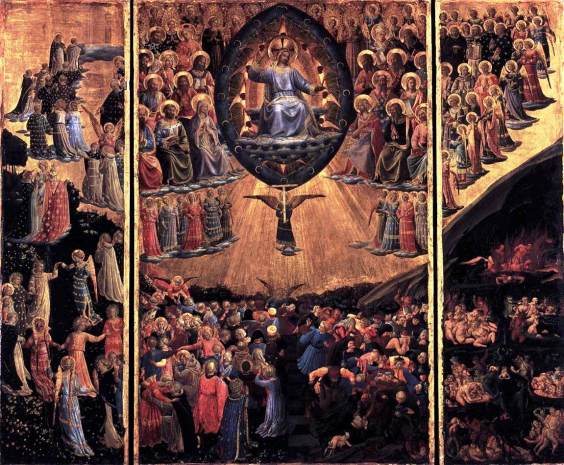
For on the Day of Judgement you won’t regret missing the extra $100,000 on your salary that you could have had — but you would regret foregoing the daily family Rosary in order to have more time to secure this salary. On the Day of Judgement you won’t regret a few people disliking you or thinking you’re weird — but you would regret keeping your Faith hidden in order to ensure you blend in well with modern society. On the Day of Judgement you won’t regret “missing out” on this or that questionable movie, book, TV show, or other entertainment that is popularly praised by your friends, neighbors, and coworkers — but you would regret the decay of the soul that you risk by exposing yourself to such garbage. On the Day of Judgment you won’t regret “missing out” on this or that college degree, sports tournament, worldly spotlight, honor or recognition that simply requires too much of you — but you would regret having spent a life waking up each morning with your primary motivation for getting out of bed being the pursuit of such utter vanity instead of the pursuit of eternal goals. On the Day of Judgement you won’t regret not having lived in a beautiful remote paradise with hundreds of acres to yourself — but you would regret the thousands of Communions – every single one of which is incomprehensibly powerful – you could have made but didn’t due to your insistence upon living in a utopia on earth. On the Day of Judgement you won’t regret having had health problems — but you would regret having spent your life expending all of your time and energy experimenting with the various health and diet fads that inundate us daily, instead of simply doing what is prudent for the sake of health and then accepting whatever suffering remains as the Will of God for your salvation and sanctification and that of the whole world. On the Day of Judgement you won’t regret not having sent your children to the “best” schools and ensured that they have the “best” opportunities — but you would regret letting the world’s values seep into their minds and hearts. On the Day of Judgement you won’t regret failing to ensure you and your family members can pursue every hobby, vacation, sport, etc., that the world insists you must engage in — but you would regret neglecting significant daily prayer time that you will need to forego to enable these interests.
In short, on the Day of Judgement, you will have precisely zero regret for all of these things you are now tempted to regret. You will only regret the times — and indeed, you will regret all such times — that you were not pursuing sanctity by refusing to strive to live in the Will of God: that same Will of God that is never more than one simple act of your own will — one simple Fiat — away from being the very essence and substance of your own life. And not only that, but helping an enormous amount of other souls avoid what is, truly, the only tragedy is so very easy: show them God’s love and they will be inspired to trust in it and themselves attain salvation; which is sainthood. I assure you it is that simple.
Show them God’s love by sacrificing the five extra seconds your day would “gain” by being in a hurried bustle at the store and, instead, treat the cashier as an actual human being made in God’s image. Look the person behind the counter at McDonald’s in the eye when you make your order and smile to brighten his day instead of pretending that you need to stare at the menu the entire time and rush out of the way the second you have finished paying.
Show them God’s love by talking to the beggar who asks you for money instead of lying, quickly saying you have none, and walking off
Though I had a recent spell of not being able to do my DWMoM walks, I still strive to live the Spirit of one. Just recently, I stumbled upon a beggar after Mass whom I had given a Rosary to the week before. He was proudly wearing this Rosary, thanked me again profusely for it, and told me “I never take it off.”
Show your family God’s love by daily ensuring that they recognize — by deeds, not words — that your primary concern is not that they fit nicely into your plans, not that they become what you want them to be, not that they merely ensure they aren’t a burden on you, but rather, ensure they recognize that your primary concern is to serve them: to will their well-being, salvation, and sanctification. But remember that in the family especially; what truly is love will not always be seen as true love by its recipients in the short term, but it will in the long term, which is what matters. Nevertheless remember as well that a love that is not tender, merciful, and compassionate, cannot be called love at all.
Show them God’s love not by pretending that giddiness and chattiness achieves anything — supposing that droning on about worldly topics is some sort of evangelization (it isn’t), or that exhibiting an obnoxious excess of joy will somehow magically attract people to Christ (it will only repel them) — rather, show God’s love by way of a deep and mature peace and joy that comes from the absence of fear, the presence of a constant spirit of prayer, and a certain awareness of the fact that nothing but God’s Will can happen.
Show them God’s love by refusing to do anything anonymously, semi anonymously, or covertly, that you wouldn’t do while looking the person in the eye — whether online comments, emails, letters, driving maneuvers, gossip, dealing with bureaucrats via phone, online, or behind a desk; or anything of the sort. Instead, show God’s love by, each and every time you hear someone detract or complain about another, being a sower of peace and helping to mend the discord instead of relishing the darkness and appreciating that venom is being directed toward someone else; falsely supposing that this somehow makes you look better.
Above all, show them God’s love by your life of prayer and sacrifice for their salvation and sanctification. This of course will garner you no praise on this side of the tomb — for it is entirely hidden — but as such, it is the most powerful and the most pleasing in the sight of God. Do thisin the Divine Will and this love you show them will acquire the strength of God’s own infinite Love.
Show them God’s love and, in some way, make sure you give Him the credit He deserves for that love, which is entirely His own. Perhaps a visible crucifix worn around the neck; perhaps a Divine mercy image pin; perhaps by handing the person a divine mercy card, perhaps by simply saying “God bless you,” or perhaps simply by nothing more than the deed itself if the one to whom it is done already knows that your love for your brothers proceeds from your love of God, and is for His sake, and is because your brother bears His image. But if you do not in some way try to make sure that God receives the credit for this love (not you), then you risk your act of mercy being nothing other than a nice (but petty) “random act of kindness,” which may succeed in briefly and weakly lightening someone’s day, but will not build up treasures for that person in Heaven.
Do these things — little though they may be — without self-interest, without desire for praise or vain glory, without any carefully devised strategy for earthly gain charting their course — and the chorus of voices that will rise to your vindication on Judgment Day would easily drown out even all of hell shouting against you.
For a few years before this particular quote, my email signature had for a long time been another quote:
…the dullest most uninteresting person you can talk to may one day be a creature which, if you saw it now, you would be strongly tempted to worship, or else a horror and a corruption such as you now meet, if at all, only in a nightmare. All day long we are, in some degree helping each other to one or the other of these destinations…. You have never talked to a mere mortal.
And yet, they are not that confusing. For one who truly wants to see the path that God has laid out for him, it is not difficult to discern.
For indeed, we are soldiers. And a good soldier need not have the whole war figured out. He just needs to know what his orders are.
So I will presently do something that I ordinarily wouldn’t dream of doing, but I feel I must do it in order to give the present distress some context that many seem to now be forgetting. I am going to write a little “rant” against a man I admire immensely. I pray to him every single day. I believe he is among the greatest saints we have had. I am incredibly devoted to his writings and missions and I promote them tirelessly:
The man is Pope St. John Paul II
I am going to issue this “rant” against him because I want to demonstrate that Pope Francis is not the the first good and holy Pope to do and say stupid things. I want to point out that you can still be absolutely submissive to a Pope’s Magisterium, be absolutely devoted and loyal to the Pope himself, and heartily endorse the main thrust of his mission and indeed make it your own mission — all while still believing that many of the Pope’s words, deeds, and omissions, are very foolish.
Because we are at the point where it is simply obvious that this foolishness applies well to many of Pope Francis’ decisions. And yet, I continue to insist as I always have: he is a holy man, the true Pope, and his mission is a beautiful one that we should all join him in.
Now onto the rant:
JPII made all sorts of terrible Episcopal appointments that have wreaked havoc upon the Church in many nations. He made female altar servers mainstream, thus leading to the disaster we see today where boys don’t want to be altar servers any more and thus a main source of vocations to the priesthood is lost. I believe he crossed the line in what is permissible within the bounds of prudence and modesty in a friendship between an unmarried man and woman (although I am absolutely not accusing him of any sort of actual unchastity! I just think he set an example in this regard that set up some weaker people to fall into unchastity by insufficiently avoiding occasions of sin). I disagree with his removal of the fig leaves from the Sistine Chapel (for the vast majority of the Sistine Chapel’s history, fig leaves made its art more modest. JPII decided to undo over 400 years of precedent by having them removed. And disagreeing with him on that, and with Michelangelo for drawing the explicit nudes in a Church, does not make you a bad Catholic!). He allowed numerous liturgical violations to occur under his watch, especially at World Youth Days. In an interview, Crossing the Threshold of Hope, he said that humans have existed for “tens of thousands of years,” which is absolutely untrue. His omission of certain infallible and essential truths about marriage from any and all of his teachings is deeply misleading, evidenced by the fact that most Catholics today seem to think that these truths can now be abandoned due to their absence in Theology of the Body (For example, despite writing countless hundreds of pages on marriage, I know of no single teaching in which he made clear the head and heart relationship between husband and wife so that people understand that 1 Corinthians 11:3, Ephesians 5:22, 1 Peter 3:1, Pope Leo XII’s Immortale Dei 17, Pope Pius XI’s Casti Connubi 26, etc., are still 100% as applicable today as when they were written, just as all Scripture and Magisterium is.) I think it was foolish and misleading of him to kiss the Quran. And I think he somewhat crossed the boundary in other ecumenical endeavors as well.
This list could go on for a long time. And I doubt anyone reading this agrees with me on all of those points. That’s okay; the purpose of this post is not those points. (So there’s no need to send me an email castigating me for them — I am not going on a crusade for any of them right now!). The purpose of listing those points is just to give context to the present confusion with the present Pope. For we all have different things about Pope Francis’ decisions, too, that we think are stupid and foolish.
But hearing all of that, are you now surprised that I have been so devoted to JPII’s legacy, so promoting his message, and so insistent upon his Magisterium, for all these years?
You shouldn’t be.
Catholics are not called to be schizophrenics. That’s a mental disorder, not a virtue. And yet, that is exactly what we would need to be in order to agree with each Pope and think that everything each Pope does is wise and right and just. For Popes all disagree with each other; often seriously. They take very different approaches. Why, for example, should I agree with Pope St. John Paul II any more than Pope St. Pius X, on those issues on which they disagreed or took opposite approaches? They were both Popes. They are both saints. Whom to side with on issues they (at least seem to) disagree on is up to you: that is, it is up to you to discern the truth for yourself and in what station God is calling you to serve. Therefore even more obviously: why should I think that Pope Francis choosing to do something that previous Popes clearly specifically chose to not do make me think that this something is right, or even okay? It needn’t. It is merely yet another thing that I can think was wrong of him to do but which need not shake my positive convictions regarding the man himself.
God doesn’t give us a Pope in order to re-write Catholicism (as if that were even possible). He doesn’t give us a Pope so that we can abandon everything that has come before and re-formulate our understanding of God and the Church from a blank slate. No. Rather, God gives us a Pope because the essence of that Pope’s particular mission is what the Church and the world really need at a given point in time.
Admittedly, Pope Francis’ blunders are more serious and more frequent than Pope St. John Paul II’s ever were. But I am writing this post to show you that the difference is in degree, not in kind. To show you that neither man’s assortment of blunders should shake your faith in the man himself. But I’m not going to give you a rant against Pope Francis here. The Catholic blogosphere is replete with endless depiction of the details of his alleged or actual blunders and also the promulgation of unfounded dark rumors with such a degree of dedication and morose delectation that would make even the most perverse of celebrity gossip tabloid editors blush. Such is the sorry state of what many corners world of conservative Catholic subcultures have descended to.
Nor am I going to give you just another post saying “only worry about submitting to what the Pope teaches infallibly and forget the rest,” as there are also already countless Catholic voices out there promoting that lie as well — a lie that only gives you a false sense of security and inoculates you against the workings of the Holy Spirit and the ability to respond to the Signs of the Times.
Instead, my exhortations to you — my Battle Orders for the Church Militant — are threefold. For the mere adherence to the dictates of any given Catholic subculture will prove radically insufficient to save you from the coming Apostasy. Only standing firm on the Rock of Christ, and the consequences of His promise to Peter in Matthew 16:18, will do that.
First) Submit to Today’s Magisterium
Submit to Pope Francis’ Magisterium. Every. Single. Word. Of. It. There are four primary Magisterial Documents that, at a minimum, everyone who calls himself a Catholic should submit to from this Pope (Chronologically):
Lumen Fidei
Evangelii Gaudium
Laudato Si
Amoris Laetitia
Put any of these documents next to even the very quintessential “traditionalist” Magisterial Document — the Syllabus of Errors — and you can rest fully assured that you will not find one single, solitary substantial contradiction in teaching. Yes, there are ambiguities in A.L. No, they do not need to be interpreted in a heretical fashion. Yes, it would be nice if Pope Francis answered the Dubia. But there’s no need for him to do so. Any Catholic who wants the truth already knows it: the Dubia’s answers are very simple and are already settled by Church Teaching we already have: No. Yes. Yes. Yes. Yes.
Second) Submit to Yesterday’s Magisterium
Through diabolical Modernism, the truth is today being assaulted more outrageously and pervasively than ever before in history. It will become increasingly difficult to stand firm on the Truth, but stand firm we must. This is not complicated. Therefore I present to you a simple list, for now, of those absolutely and unquestionably infallible, permanent tenets of the Truth that you will soon be demanded to recant by the devil and his minions. And recant any single one of these you must never do. Rather, set your face like flint right now to stand firm by them, come what may:
No intrinsic evil can ever be licitly undertaken in any conceivable circumstance. Committing an intrinsic evil is never compatible with God’s Will and is never right or okay.
Formal cooperation with any intrinsic evil is never licit
Fornication, adultery, masturbation, direct abortion, suicide, and homosexual acts are intrinsic evils
Marriage is absolutely indissoluble
The Catholic Church alone has the fullness of the truth, and God calls all men to be under the authority of her Earthly head, the Successor of St. Peter, who is the only Vicar of Christ.
Every single one of her dogmas — including those pertaining to morals — are absolutely infallible and categorically impossible to ever deny or change.
Although the inclination itself is morally indifferent, homosexuality is nevertheless intrinsically disordered. As such, any good that seems to proceed from it is in fact accidental to it, and was not directly caused by it (for contradictories cannot be causes). Footnote 1.
Sacramental Absolution is impossible to be validly and efficaciously granted to one who is without any way, shape, or form, of repentance of deliberately committing an intrinsic evil
How, when, using what words, and to whom to preach these truths is another question entirely. It is one of prudence and prayerful care. Mastering this balance may well take a lifetime. But knowing and submitting to the principles is not. Rather, it should not take more than a few moments for any catechized Catholic. These principles themselves — including each and every one of them listed above — are absolutely black and white. You must never, ever, doubt, reject, or contradict with your own behavior, a single one of them. No matter who tells you to do so. No matter how many other people are doing it and saying it’s okay. No matter how many people you once trusted are now performing these acts.
But please note, friends, what is deliberately absent from this list of absolutely certain tenets we must stand by:
Precisely when Material Cooperation with evil (or silence in the face of it) is permissible or called for is an entirely different question.
Do not dare appoint yourself the judge of this against those under whose authority God has placed you — judging them as evildoers by standards that you yourself (though you may be too blind to now see it) will also fall by on the Day of Judgement. Recall especially that the measure with which you measure will be measured out against you, and this is doubly true when you measure out condemnations on the Vicar of the Second Person of the Eternal Trinity.
Precisely what degree of avoiding the occasion of sin and avoiding scandal is required in order to validly confer absolution on a penitent is also not a clear Dogma that you have the right to draw your own line in the sand on and judge the Vicar of Christ by.
Just what degree of evil to tolerate occurring as a consequence of one’s actions so long as that evil was neither undertaken nor directly willed (i.e. Double Effect)
Third) Engage in Today’s Mission
Heed Pope Francis’ call — that is, the essence of the mission that God has appointed him to this time for — and make it your own. His mission is a final, pull-out-all-the-stops proclamation of the Divine Mercy while there is still time left to do so.
For God appoints men to a task for the sake of the main thrust of their mission. Aside from the men who wrote Sacred Scripture and the infallible proclamations of the Popes, God does not micromanage their undertaking of the mission to ensure the perfection of each of their decisions. It is certainly beyond obvious that God is not doing so with this Pope! So it is the essence of the mission we must focus on: a mission that I have spoken about incessantly on this blog for the last five years or so.
Now enough of that. I run a Catholic blog and for over two years I haven’t made a single substantial contribution to the various raging Pope Francis controversies; striving as I have been to take my own advice. And I almost wonder if I should have even published this one. Alas, I have done so, and alas, it is time to return to what is actually important instead of addressing endless pointless controversies:
THE MISSION
When I realized how important this mission was, I made it the primary page on this blog’s main index: www.dsdoconnor.com. And I would now like to present to you more inspiration for carrying out the Battle Orders for the Church Militant — The Mission — to the fullest:
Hacksaw Ridge
Not since years ago, when I urged everyone to watch Beyond the Gates, have I been able to so heartily recommend a movie as I now recommend Hacksaw Ridge.
It is an antidote to the typical modern movie: for it has almost everything a story should have, in contrast to almost every other modern movie which has nothing a story should have and everything a story should not have. Instead of an anti-hero, Hacksaw Ridge gives us a hero. Instead of encouraging sin, it encourages virtue. Instead of providing mere eye candy, all of its action is provided for a higher purpose, without admixture of morose delectation or vainglory. Instead of providing existential nihilism, it provides Divine Purpose and Plan. Instead of merely giving us a way to pass the time (“as if one could kill time without injuring eternity“), it helps us to choose the good, which is the purpose of all art and the ultimate standard by which all art must be judged.
And indeed, instead of being just another Hollywood screenwriter’s daydream, it is non-fiction. Now, unlike the aforementioned ailments, there is nothing wrong with fiction in and of itself (rest assured there is no greater fan than I of Lord of the Rings and the Chronicles of Narnia, for example). But it is equally undeniable that today we suffer from fiction overload and non-fiction atrophy. For we forget that no effect can ever be greater than its cause; and the cause of any good in fiction is the wisdom of the author, whereas the cause of whatever good can be gleaned from reality – in other words, non-fiction – is none other than God. Therefore the former is severely limited in its fittingness as art; more or less so depending upon the wisdom of the author, whereas the power of the latter as good art is without bound. And what a travesty that, for decades and decades, Hollywood has been too busy deluging us with endless comic book movies that this true hero’s story was left untold by them.
Now I must briefly interject an advisory: Old time readers here know that I would never, ever accept or promote a sex scene (regardless of whether it is graphic or restrained; glorifying promiscuity or condemning it; real or simulated), for any sex scene is, by its very nature, pornographic, and therefore evil. This is taught quite unambiguously by Catechism, paragraph 2354. Yet I am quite confident Hacksaw Ridge has none; and although there is one questionable scene we skipped past when my wife and I watched Hacksaw Ridge, the parent preview websites seem in agreement that there is nothing but an implication that newlyweds consummated their marriage AFTER the scene– in which nothing major is shown– ends. Furthermore, there is some minor crude dialogue that I could have done without; especially in the barracks scene. It is not a perfect movie, but it is nevertheless a movie that I heartily endorse for adult audiences.
Allow me next to assuage any concerns you may have had in hearing of the premise of this movie or seeing its preview. It is not pacifist propaganda. It is a story of a man with the courage to be true to a personal vow he made; not some debate glorifying an erroneous theological position (that killing is in and of itself an intrinsic evil or that there is no such thing as just war). It is furthermore pragmatic in this regard: for the main character’s ultimate justification for his position is “With the world so set on tearing itself apart, it don’t seem like such a bad thing to me to want to put a little bit of it back together.” This justification we too can give for deciding to focus our own apostolates on proclaiming the Divine Mercy instead of succumbing to the scrupulous fear that we are neglecting the Divine Justice in so doing.
For I do not write this to give you a mere movie review. I write this to encourage you to draw inspiration from the most important teaching of the movie:
JUST. ONE. MORE.
In these final few days of the Time of Mercy, this must be our rallying cry. This must be what gets us up in the morning. This must be what urges us on despite the seeming insurmountable obstacles and the temptation that swirls about us on every side insisting that we give up, rest, and forget about the Salvation of Souls and the Coming of the Kingdom of the Divine Will.
It does not matter how many days are left in the Time of Mercy. All that matters is that there is still breath in our lungs; still blood coursing through our veins; still the ability to rouse ourselves as the soldiers we are to fight this most worthy battle… and still a single soul left who can benefit from our resolve.
You. can. still. save. one. more. soul.
Every day.
No one can stop you.
Let all the world conspire against you – wage total war against you – it would be utterly powerless to suppress the power of your will, entirely submitted to the Divine Will and living in It, yet never failing to exert itself in accord with its proper end, from fulfilling its Divine Calling of achieving the salvation of souls.
This must be the approach of any Catholic who is now confused as to the path he should be taking: that of mercy, or that of justice. I hate heresy as much as anyone and I am as concerned as the next man of errant interpretations of Amoris Laeititia that essentially normalize divorce and/or adultery, or turn the Commandments of God into mere “ideals.” And yet, I remain utterly convinced that the general approach of mercy is still the one that the Holy Spirit needs of us today. For few of us are theologians; few of us are Canon Lawyers; few of us are Bishops. On the other hand, almost all of us are confronted every day with so many souls wounded from this sickening, sin and error infested world over which the devil has reigned with unprecedented power for the past 100 years.
In a word, as the Holy Father has said so many times that too many of us have become tired of hearing it:the world needs a Field Hospital, and the Church must be that Field Hospital. This is the main thrust of Pope Francis’ mission. That it is better to risk injury by going out to the gutters than it is to ensure sickness by remaining stuffed up within our own artificial realms of safety, security, and comfort. That it is better to be a warrior than a commentator. That it is better to be a witness than an apologist.
And the Church needs us to be modern day Desmond Dosses manning this Field Hospital that the Church must be.
But we are not on a literal battle field with wounded soldiers lying all around. So how do we say, and act on, “Just One More”?
First of all by recognizing that boredom is a sin. Over 150,000 people die every single day in this world. You are your brother’s keeper, and you have a duty to strive to ensure that as many of them as possible make it to heaven. Therefore, say:
Just One More when you hand out an Evangelization Card to someone or place it somewhere knowing that it will be picked up and knowing that Jesus promised that whoever venerates that image shall not perish
Just One More when you read the Hours of the Passion – carefully and prayerfully – knowing that Jesus promised the salvation of a soul for every word of it read in such a manner.
Just One More soul when you say “God Bless You” to someone on a Divine Will Missionaries of Mercy walk, knowing that this simple interaction can be a channel of grace into his heart and effect his salvation
Just One More soul when you drag yourself yet again to the local Planned Parenthood to pray and sidewalk counsel
Just One More whenever you choose to pray for the salvation and sanctification of souls instead of engage in some vanity, pleasure, hobby, or waste of time
Just One More when you spend time praying with the residents of the local nursing home
Just One More when you abandon human respect and instead use opportunities daily life presents to draw souls to Christ — holy bumper stickers, pins, a visible crucifix, a lawn statue of Our Lady, holy salutations, holding & praying a Rosary while walking, etc.
Just One More whenever you choose to associate with the lowly and the needy instead of those you merely enjoy yourself around, knowing that it is through association with the former that we may more effectively draw souls to Christ
Just One More whenever you wake up on a Wednesday or Friday and decide to fast and offer it up for souls — knowing that God will accept your sacrifice — instead of letting the desire of the flesh guide you.
Just One Morewhen you go to morning daily Mass for the three thousandth time, no matter what you feel like doing when you wake up, knowing that the power with which you can save souls there is unparalelled
Just One Morewhen you pick up your beads and do your Daily Rosary, no matter how busy you are and no matter how tempted you are to think it useless, knowing full well that Our Lady has promised that she will conquer the world through this most sublime devotion Therefore let us say, with Desmond Doss of Hacksaw Ridge, “with everyone in this world intent on tearing his enemy to shreds, I will rather dedicate myself unreservedly, with no thought to my own safety or self interest, to snatching souls out of this fire of evil and drawing them to the Divine Mercy. Every breath God blesses me with is one more opportunity to say: Just One More Soul. Every blow God allows me to receive is one more opportunity to allow grace to touch the heart of its originator. And I will not spare one drop of my sweat or blood in ensuring that I do not neglect a single one of these eternal opportunities. I’ll rest when I’m dead.”
.
.
.
.
.
.
Footnote 1: As this is a delicate issue wrought with confusion on both sides, allow a little clarification. There are very many very good people who have the homosexual inclination. To argue against this reality by saying “the inclination itself is also sinful and therefore all who have it are to be condemned” is blasphemy against God’s goodness, for He gives everyone the grace to avoid every single sin, yet He does not give everyone the grace to be (immediately) free of an inclination. Anyway, it may seem that the good those with a homosexual inclination do proceeds from this inclination. But it is not so. Rather, the good they do can only possibly proceed from some other thing within them, which an onlooker and perhaps even they themselves confuse with the homosexual inclination. For example: consider alcoholism; also intrinsically disordered, for it is an inclination to an excess and a sin (drunkenness). Alcoholics often do good things; for their “all or nothing, all out, hold nothing back” approach to life often enables them to achieve great success in certain realms by guarding them against a petty and bland life. Nevertheless, none of these good things can correctly be said to have proceeded directly from the alcoholism. Rather, the alcoholism and the good thing both proceeded from a deeper, morally indifferent, tendency.






 Daniel O'Connor's Blog